
Menu
-
- Home
- Specialty Shape / Coastal Beach Molds
-
Woodworking Silicone Molds
-
Floral/Preservation Silicone Molds
- 2" & 3" Deep Alphabet Letter Molds
- 3" - 1.5" Deep Picture Frame Molds
- 3" Deep Hexagon Silicone Molds
- 3" Deep Square Molds
- 3" Deep Bookend Molds
- 3" Deep Arch Mold
- 3" Deep Heart Mold
- Deep Gem Molds
- 1.25", 2" & 3" Deep Cross Molds
- Memorials/Remembrance
- 3" Deep Rectangle Silicone Molds
- 3" Deep Large Round & Oval Molds
- 3" Deep Standing Round and Oval Molds
- 3" Deep Rainbow Molds
- 1.25" Deep Charcuterie Board Mold
- 1" - 2" Deep Square Molds
- 1" - 2" Deep Rectangle Molds
- 1" - 2" Deep Round Molds
- Specialty/Holiday
- 1" Deep Coaster Molds
- Paper Weight Molds
- Ornament Molds - Donut & Round
- 1/2" & 3/4" Serving Tray Molds
- Add-Ons/Functional Molds
- Resin Tools & Accessories
-
Arts & Crafts, Trays, Keychains, 3D, and more
-
Eye Candy Pigments
- Promise Epoxy
- Clearance - B Grade
-
- Contact Us
- Login
-
USD
hi
A column with no settings can be used as a spacer
Link to your collections, sales and even external links
Add up to five columns
hi
A column with no settings can be used as a spacer
Link to your collections, sales and even external links
Add up to five columns
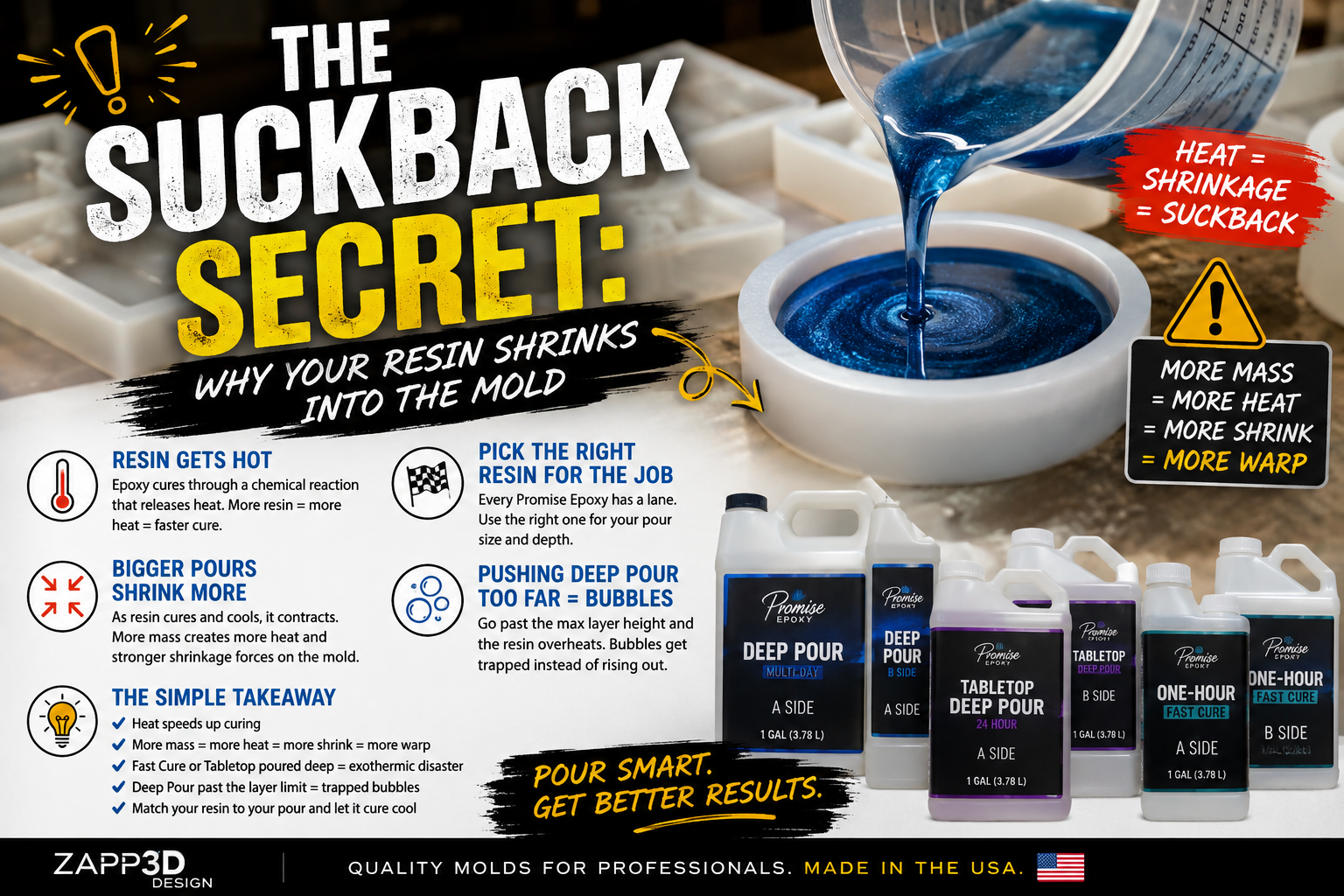

Why Epoxy Resin Warps Silicone Molds: Heat, Shrinkage & Suckback Explained
August 20, 2026 4 min read
The Suckback Secret: Why Your Resin Shrinks Into the Mold
Have you ever poured a beautiful resin piece, walked away, and come back to find the sides of your mold pulling inward?
Your first thought might be:
“What happened to my mold?”
But the mold may not be the problem at all.
What you're seeing is something resin artists often call suckback—the result of heat, curing, and shrinkage putting pressure on the flexible walls of your silicone mold.
Understanding why this happens can help you choose the right resin, protect your molds, and get better-looking castings.
🔥 First: Resin Gets HOT
Epoxy doesn't simply "dry." It cures through a chemical reaction between Part A and Part B.
That reaction produces heat, known as an exothermic reaction.
And here's the important part:
The more resin you pour at once, the more heat that can build up.
A small coaster and a large floral preservation piece may use the exact same resin, but they can behave completely differently.
A larger mass holds onto more heat. That heat can accelerate the curing reaction, which creates even more heat.
That's why choosing a resin based on pour size and depth is so important.
🧪 Pick the Right Resin for the Job
Not every epoxy is designed to do the same thing.
Think of each resin as having its own lane.
One-Hour Fast Cure
Perfect for smaller projects where you want a quick turnaround.
Think:
-
Keychains
-
Small molds
-
Coasters
-
Shallow pours
But that speed comes from a fast curing reaction.
Put too much Fast Cure resin into a large or deep mold and the temperature can rise extremely quickly.
Small + shallow = great.
Large + deep = trouble.
Tabletop Epoxy
Tabletop epoxy gives you more working room, but it's still designed primarily for thin applications and shallow pours.
It's sensitive to the total mass of resin being poured.
Push it too deep and you can create excessive heat, rapid curing, bubbles, distortion, or even damage to your casting.
Deep Pour — 24 Hour
Now we're getting into thicker pours.
A 24-hour deep pour resin gives you more depth while still curing relatively quickly.
But remember:
Faster cure + large mass = more potential heat.
As your pieces get larger and deeper, temperature becomes increasingly important.
Always follow the manufacturer's recommended maximum pour depth and consider the overall size of the casting, not just its depth.
Deep Pour — Multi-Day
For our largest molds, a slower-curing deep pour resin is often the better choice.
Why?
Because slower curing generally means less aggressive heat buildup.
That extra working time also gives bubbles more opportunity to rise naturally before the resin begins to gel.
The trade-off is patience. You'll be waiting longer before demolding, and some slow deep-pour formulations may have different final hardness characteristics than faster systems.
But when you're pouring a large volume of resin, slow and steady can be your friend.
😮 So... What Is “Suckback”?
Here's where things get interesting.
Resin changes as it cures.
There can be chemical shrinkage during curing as well as thermal contraction as the casting cools back down.
Your silicone mold, meanwhile, is flexible.
As a large resin casting cures and contracts, those forces can pull against the mold walls.
The result?
👉 Walls bowing inward
👉 Dips or distortion
👉 A casting that isn't perfectly straight
👉 A mold that looks like it's being “sucked” toward the resin
That's what many resin artists describe as suckback.
And the larger the casting, the more noticeable these forces can become.
⚠️ Bigger Isn't Just Deeper
This is one of the most important things to understand.
Pour depth isn't the only thing that matters.
Imagine pouring resin 2" deep into a 4" mold.
Now imagine pouring that same resin 2" deep into a 24" mold.
Same depth.
VERY different amount of resin.
The second casting contains significantly more mass, which can retain much more heat during the curing process.
That's why you should consider:
DEPTH + TOTAL VOLUME + RESIN TYPE
—not depth alone.
🫧 Too Much Heat Can Also Mean More Bubbles
Deep-pour resin is designed to cure slowly enough to handle larger pours.
That slow cure gives bubbles time to rise and escape.
But every resin has limits.
Push a resin beyond its recommended pour depth or volume and temperatures can climb higher than intended.
The resin may begin curing faster, reducing the amount of time bubbles have to escape.
Instead of reaching the surface...
they can become trapped inside your piece.
If you're struggling with bubbles in your larger castings, don't automatically blame the mold.
Take a look at your resin, pour depth, total volume, and curing temperature too.
The Simple Takeaway
When you're working with large silicone molds, remember:
🔥 More resin can mean more heat
🌡️ More heat can accelerate the cure
📉 Resin contracts as it cures and cools
↔️ That contraction can pull flexible mold walls inward
🫧 Excessive heat can make bubble release more difficult
🧪 Your resin needs to match the size AND depth of your project
Most importantly:
Don't choose your epoxy based only on how quickly you want your piece finished.
Choose it based on what you're actually pouring.
A resin that's amazing for a coaster may be completely wrong for a large floral preservation piece.
Follow the resin manufacturer's recommended pour limits, keep your curing environment in mind, and when you're working with a large volume of resin, slower is often better.
Better Resin. Better Technique. Better Results.
At Zapp3D Design, we make silicone molds for everything from small resin projects to large professional floral preservation pieces.
Our goal isn't just to make quality molds—it's to help you understand how to get the best results from them.
Because when you understand what's happening inside the mold, you become a better resin artist.
Pour smart. Create something incredible.
Always follow the epoxy manufacturer's current mixing, temperature, maximum pour depth, and safety recommendations for the specific resin you're using.
Leave a comment
Comments will be approved before showing up.
Sign up for new products alerts and discounts!
Sign up below!